
Fighting for the soul of America!
or How to be a Delegate

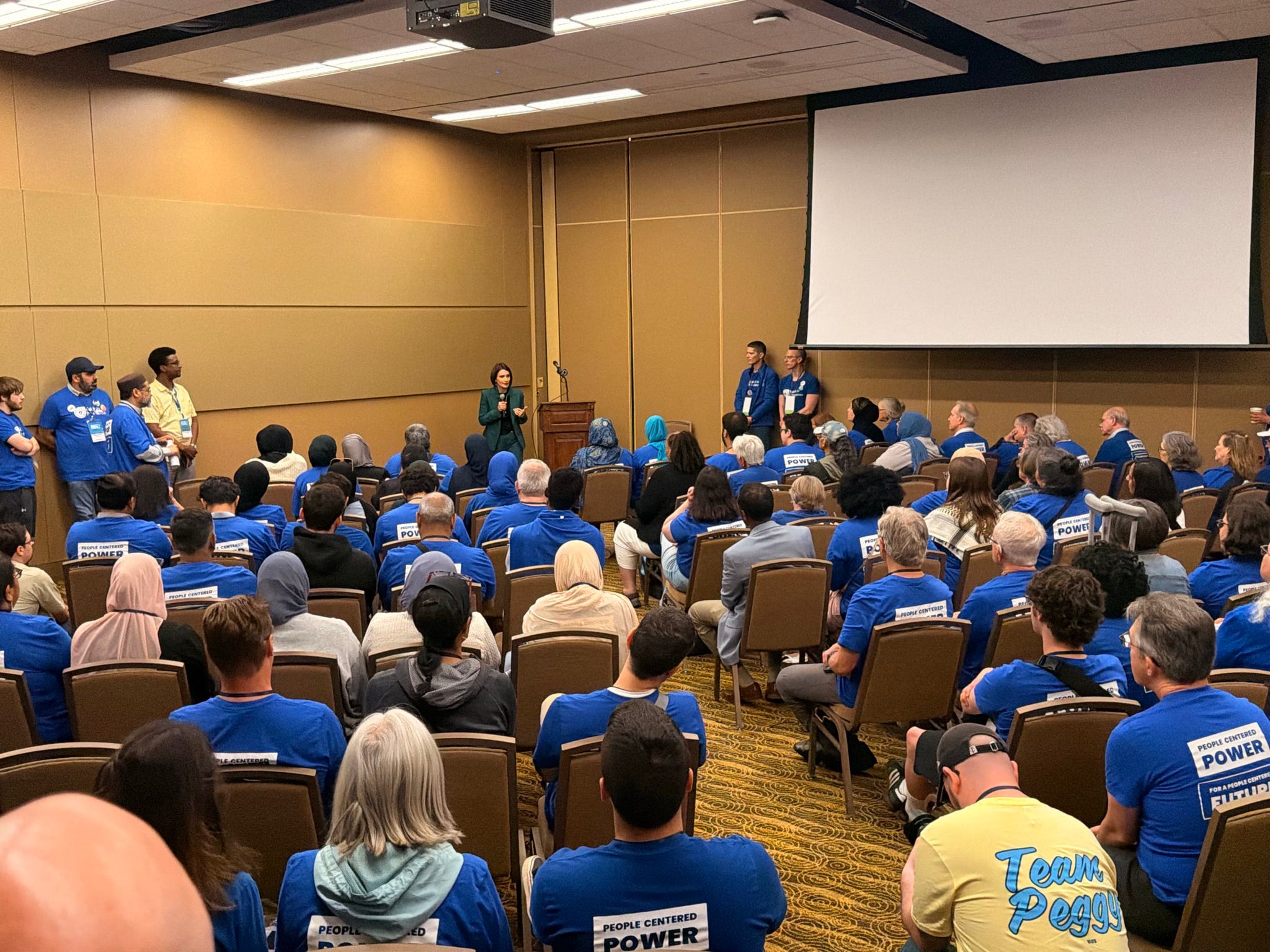
Officially convention season is over. Here in Minnesota anyway. I don’t know what is happening elsewhere. Back on February 3rd this whole thing got started when I attended my precinct caucus and signed up to be a delegate to all the organizing units I could—Senate District 61, the Minneapolis City Convention, and our Hennepin County Endorsing Event. At Senate District 61, I was honored to be elected as an alternate to two further conventions, Congressional District 5 and the State Convention, and now I have been to them all. Thanks to those of you that helped me get there.
I have no regrets, but it has been a haul.
Hennepin County Convention, the last of them, happened yesterday. I had been looking forward to this, thinking the work was over, but —sigh— democracy doesn’t work that way. The State Conventions took place two weeks ago on May 29 - 31st, made me see how endorsing is just the first step. Gearing up for the Minnesota’s primary election on August 11th is next. If the collective wisdom that grew from that first meeting at the precinct caucuses is to be honored, there will be more work to do, even if it is just talking to all of my friends and neighbors about what we decided and why.
I’m starting that today with this rising crescent of a New Moon.
Make a plan to vote!
In Minnesota, early voting for the primary will begin in Minnesota on Friday, July 24. I already know I will be casting my ballot at the Early Vote Center in Minneapolis as Family Camp conflicts with the primary.
Here is where you can find information on Minnesota voting: Elections & Voting. Article I, Section 4, Clause 1 of the Constitution, known as the “Elections Clause,” gave states the responsibility of overseeing elections. If you live in another state and don’t know where to find out about voting, here is a link to the National Association of Secretarys of State (NASS) “Can I vote?” page. NASS is a non-partisan website created by state election officials to help people figure out voting. Disenfranchisement is happening by leaps and bounds just now, so helping yourselves and others early to make a plan just makes sense.
Understanding “organizing units”
At the very beginning of this process, I drew myself a map to try to understand which candidates would be endorsed at which event. My little drawing had each convention on one side with the list of offices that would be endorsed on the other. It took that activity to help me see these “organizing units” that I kept hearing about as containers of constituents for various levels of government. It took a shift in perspective to understand how my precinct(the smallest container that defines my direct neighborhood) fit into the Venn Diagram that was State Senate District, Minneapolis City District, and Hennepin County District, each bigger container encompassing the previous. My drawing included a section that grew out from our State Senate District showing that delegates would be chosen from there to go on to two further conventions and endorse federal candidates. The US Congressional District was where our US Representative was endorsed and the Minnesota State DFL Convention where State Auditor, Secretary of State, Attorney General, and US Senator, and Governor.
How being a delegate is powerful
Some of these offices were a mystery to me. State Auditor? County Commissioners? But by last February, in the midst of Metro Surge, when I was signing up to be a delegate, I was beginning to understand that some of these county positions in particular were going to play an outsize role in responding to the stressors caused by a federal administration determined to punish our state specifically and, more generally, punish the most vulnerable of its citizens.
Once you become a delegate or alternate to a particular convention (you do not have to do them all!) your name is on a list and the candidates that are seeking your party’s endorsement begin to call you and knock on your door and try to find out what issues you care about and if they can earn your support. And that was why Faith in Minnesota urged all leaders to go to their caucuses with The People’s Agenda in hand and get candidates talking about how they could bring this vision of the future into reality. The People’s Agenda was created through deep listening sessions with Minnesotans across the state. Over 10,000 people weighed in—across race, faith (or no faith), age, gender. This values-based agenda has mass appeal and spells out a future that is rooted in affordability, dignity, and community. Our coalition of delegates and alternates at the DFL State Convention was over 200 strong.
A Convention and its Norms
Hennepin County was last on my list, because it came last in order. Technically the Hennepin County Convention was an “endorsing event” because the only business conducted there was candidate endorsements. As a Faith in Minnesota Delegate, I arrived with the mission to secure the endorsement of the candidate that we felt would be the best at partnering with us to pass the budgets, policies, and programs that bring our vision of The People’s Agenda into reality. In the auditorium at St. Louis Park High School we were assigned to sit by districts, as was the case in most of the conventions I attended. Finding where that is involves jostling through crowds and deciphering codes left on aisle rows with post-it notes. The aisles are full of delegates wearing the t-shirts of their cause/candidate/union of choice and also volunteers and candidates. And it is while everyone is settling in and trying to figure out what is going on that you also introduce yourself to those around you and have persuasive conversations. I did my best to ask what made them get involved in the process and followed that up by asking if they were familiar with Faith in Minnesota and The People’s Agenda and who they were considering for County Attorney.
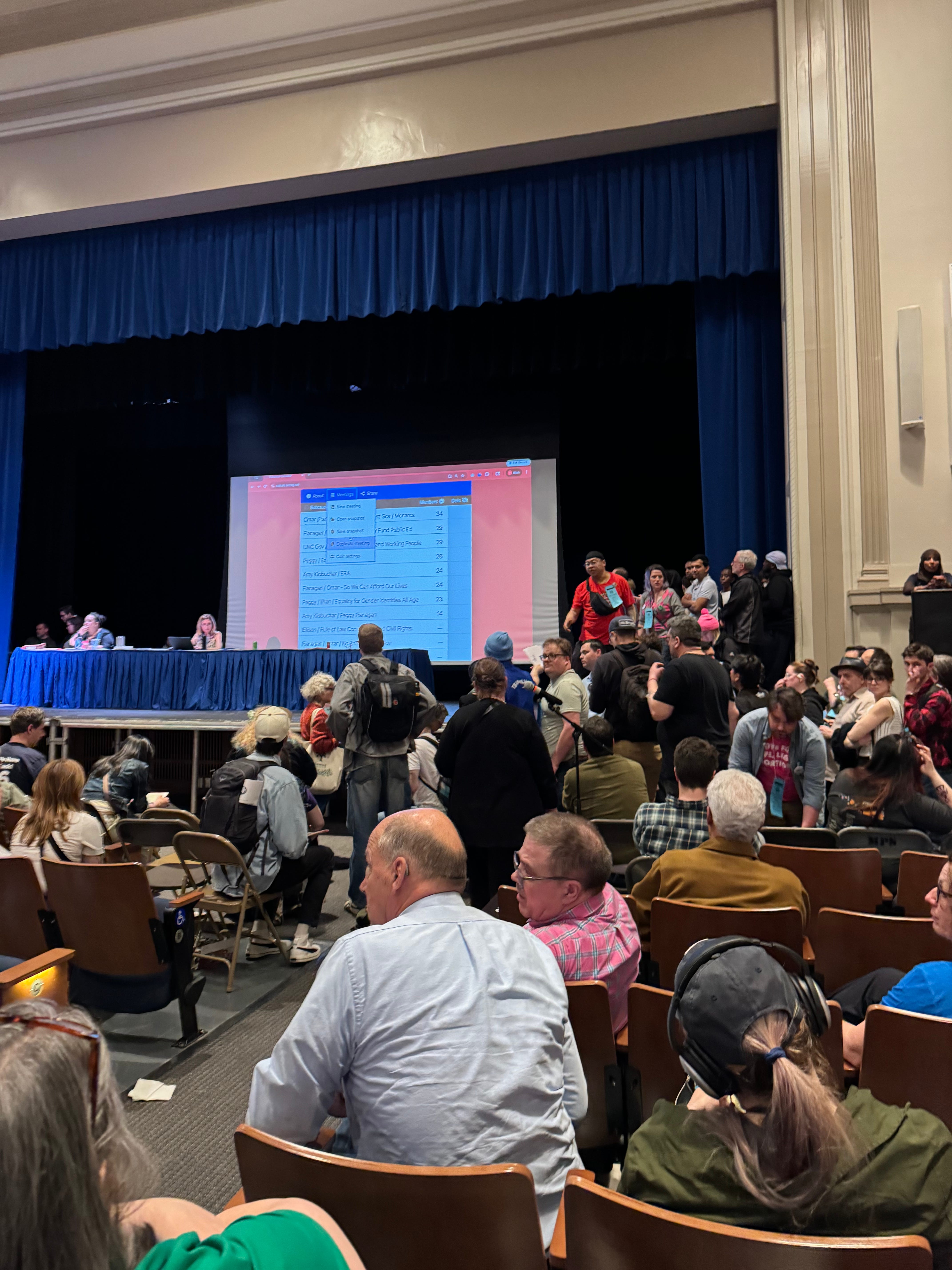
At yesterday’s convention, we got stuck on our very first candidate. And that was surprising because she was an uncontested incumbent. The endorsement of Dawanna Witt for Hennepin County Sheriff went into five rounds of voting without her clearing the 60% mark needed to receive the endorsement, despite the fact that she had no one running against her.
During the voting, I was sitting beside a young person who explained that they signed up to be a delegate to this convention after Alex Pretti was killed in their neighborhood. In the aftermath of his murder the neighborhood was understandably agitated. I felt the unrest from my neighborhood three miles away. The Hennepin County Deputies had been called in to keep the peace on Nicollet Avenue. What they described seeing on the street that day was a line up of deputies with backs to ICE agents, as if those armed agents were in danger from the citizens with whistles. My convention neighbor described how disturbing and demoralizing this image was in the face of Alex Pretti’s violent and very visible death earlier in the day. They explained that in front of citizen witnesses, ICE agents had been out of control and violently killed an innocent bystander and rather than keeping the peace, those officers were further traumatizing citizens by protecting the ICE agents over neighbors and Constitutional Observers. My seat neighbor described what a large number of Witt’s constituents have questioned. Did her deputies come to the aid of ICE agents despite the separation order of the city? Many of her constituents were motivated to be present at her endorsing convention because they believed her department had cooperated with ICE, despite the fact that she has declared that is not the case.
At a convention, one of the first things you do is ratify the rules of the convention. The parliamentarian makes sure we are following the rules. The chairs and vice-chairs attend to timing and can rearrange business in order to make sure we are efficiently using our time. At times, delegates will make motions to suspend the rules in order to change the order of things to make things more advantageous for their candidate or issue. Or to insure their issue gets attended to early, so they can leave for the day. There are lots of shenanigans and very often it is confusing and hard to track.
At the beginning of the day, we ratified rules that required that nominations would be seconded by at least fifteen people. Once they are nominated, each candidate gets an eight minute speech to explain why they are deserving of the endorsement followed by all candidates participating in a twenty minute Q&A. One delegate speaker declared that requiring fifteen seconds is an example of the convention system being undemocratic. Requiring fifteen people to second a nomination is an illustration of the push-pull of the convention process. On one hand it speaks to saving delegates the eight minutes of time for a speech from a candidate who is unlikely to win an endorsement. Or does it keep a citizen from their chance to speak their truth and shape the whole delegation? Many of the rules feel like six of one, half dozen of the other.
Despite the confusion and the time-investment, the grassroots nature of caucuses makes it possible for most everyone to get involved in the process of democracy. Anyone can get involved as long as they show up at the designated time and stay through the confusion to speak their mind, shaping the party and the candidates and each other in the process. On the other hand, all the ways leaders try to hurry it up or make it less unwieldy has a tendency to exclude participants.
The rules we ratified Saturday morning said that only after three rounds of voting would a motion for no endorsement be allowed. The parliamentarian judges whether something is allowed by the rules, or if it is “out of order.” Once the third round of voting for Witt’s endorsement was completed without a clear 60% going either direction, a delegate made a motion of “no endorsement.” After it was seconded (only requiring one), there is a period of time where three delegates can speak out for the motion and three delegates can speak out against the motion. Delegates step up to microphones on either side of the room and tell the delegation why they should vote for no endorsement, “she worked with ice.” Or why they should vote against, “I was in the room at the very tense moment when she very clearly said to Homan, I will not cooperate with ICE.” Or yes again: “Maybe she wasn’t participating, but her deputies were out of her control.” And no again: “There is a GOP supported candidate running against her.” And yes: “Her election is certain, this ‘no endorsement’ will be the slap on the hand she deserves.” and on until there is no one left to speak. Sometimes these speakers are so helpful in illuminating to the confused delegation what is going on behind the motions, that you cannot help be grateful to the delegates that go up to offer “points of information” and ask for clarification.
After the period of debate, then the body can take a voice vote. The chair asks everyone to say aye, if you approve. A pause while the delegates respond. Or nay if you don’t. If the results are not clear by listening, they follow that up with “acclimation,” which is raising ballots for the designated tellers to come around and count.
Here I can’t really remember what is what. I think voting by acclimation can happen on uncontested candidates or a motion as long as it is a simple yes or no. And in the case of this “no endorsement” motion, we went to acclimation where delegates raised their badges for a yes vote, which were then counted. Followed by all those who vote “no” raising badges, and after that, even counting who abstained. I believe a “no endorsement” required 2/3 approval by the delegation before it would pass. We did not reach that proportion and proceeded to two more votes before Witt chose to no longer seek endorsement.
Some unrelated notes from the DFL State Convention in Rochester
The charging station on the floor was great fun! Along the wall Convention volunteers set up charging areas. Bundles of power cords emerging from the wall along a counter height table. I spent a good 15 minutes there talking up a Faith in Minnesota candidate to another delegate seeking power from the cords snaking out of the wall there. It was also where I met up with my dear high school friend Constance Lindstrom, formerly Luhman, as she was a delegate from congressional district 7.
“No Data Center” movement has lots of support from a wide demographic range.
The GOP State Convention held 30 seconds of silence for Derek Chauvin, the officer who killed George Floyd, just 2 days after the 6 year anniversary of his death. No, Chauvin is not dead, he is in prison for murder. We got news of this action while we were on the convention floor.
Out of the 29 total delegates from Senate District 61, 27 showed up. Amazing! So only two of the Alternates got a permanent upgrade. The rest of us had to wait in the wings for our opportunity. It’s a complicated formula to know who would be the next person to deserve an upgrade. Especially in districts like ours where we did walking caucuses and there was a lot of competition for the spots. Each sub caucus group delivered a list of candidates and alternates with a priority order based on election results. As an alternate, I got to know the process, and I appreciated the way the credential committee volunteers stood available to consult on whether and how I could get on the floor. And, despite the electronic voting issues, it was a good failsafe as in the case of people being on the floor after their delegate returned.
My delegate was so kind to check out just to give me time on the floor. And as an alternate, I got to hit the sack at a more reasonable hour than the delegates. They were on the convention floor until 1 in the morning both nights. When it got to be 10 at night and we only had our perch from the balcony to look down on the action, “like angels” someone said (it felt more like lurking), so we went back to the Airbnb and to bed.
Short Updates Section:
due to extensive Convention Breakdown the recent
Funding of DHS is all I will cover -
Early in the morning of June 5, 2026, the republicans funded DHS. In addition to the original amount of $191 billion to fund all of the Department of Homeland Security, about $75 billion of it for ICE from HR1 (as I heard people calling it lately) or the “Big Beautiful Bill” they added funding of about 70 Billion dollars that covers the remainder of Trump’s term and calls for no regulation of ICE pr BPD officers.
Quote from Heather Cox Richardson’s letter of June 6, 2026:
Putting more billions behind ICE and CBP now will mean those agencies are funded through the rest of Trump’s term. Even if Democrats take control of Congress after the midterms, the funding will be in place, preventing Democrats from using funding to demand reforms.
How those tax dollars are being spent is a question. In February, twenty-one Democratic senators wrote to the Congressional Budget Office to note that there had been no public accounting of how that money was being spent. Adriel Orozco of the American Immigration Council reports that while the OBBBA gave ICE $45 billion for detention through September 2029, former Department of Homeland Security secretary Kristi Noem decided to use $38 billion of it to buy warehouses and convert them to detention centers.
Read more of what she accounted here.
Here is a quote from the DC Bureau of the Reformer’s accounting of Donald Trump signing it into law on June 10, 2026:
Nearly every Republican in the House voted to approve the measure, though New Jersey Rep. Thomas H. Kean, Jr., who has been absent due to an undisclosed illness, and South Carolina Reps. Nancy Mace and Ralph Norman, who were competing in their state’s gubernatorial primary, missed the vote.
Alaska Sen. Lisa Murkowski was the sole Republican to vote againstapproving the legislation in that chamber, writing in a statement negotiators should have worked out a bipartisan solution in the annual funding bill instead of using the complex budget reconciliation process to get around procedural votes that would otherwise have required the support of 60 senators.
“By choosing to appropriate funding for three fiscal years instead of one, this measure weakens the normal budgeting process and sets another precedent for avoiding it when we find ourselves in disagreement,” she wrote. “In doing so, it reduces Congress’ ability to apply reasonable checks on immigration policy for the remainder of this administration and into the next.”
Murkowski added that she would have voted for the package had it “provided immigration funding for one year, included clear restrictions on what those funds can be used for, and eliminated any potential for taxpayer dollars to be allocated to the administration’s brazen ‘anti-weaponization’ fund.”
This is a travesty and I am publishing here to account for this astonishing waste of taxpayer funds and disregard for the protections that keep citizens safe.
for your musical solace and consolation:
For Your Soul, Josh Ritter— YouTube or Spotify
The Room Where it Happens, Leslie Odom Jr. — YouTube or Spotify